You must not be misused, overused, or abused, but you must be of use to someone other than yourself.
— Maya Angelou
You must not be misused, overused, or abused, but you must be of use to someone other than yourself.
— Maya Angelou
Ideas are worth nothing unless executed. Ideas are just a multiplier. Execution is worth millions.
–Derek Sivers of CDBaby
Location: Kaneohe, HI; Lancaster, PA; Saratoga Springs, NY
Terms: Summer 2003 – 2009
Class size: ~ 30 students/term
FCPS is an introductory computer science course offered by Johns Hopkins Center for Talented Youth, a program serving talented & gifted teenagers. Students in FCPS study algorithms, Turing Machines, programming, recursion, data representation, digital copyright, digital ethics, artificial intelligence, and game design.
If you’re just beginning to learn about web development, W3School.com is an essential resource with examples and tutorials in HTML, XHTML, CSS, JavaScript, AJAX, jQuery, and many other technologies.
The Web Style Guide, 3rd edition, from Yale University Press is an essential read for any beginning web developer or designer.
Audacity is a free, cross-platform sound editor.
Notepad++ is a free, Windows-only text editor offering syntax coloring, line numbers, and other programmer-centric features.
TextWrangler is a free, Mac-only text editor with advanced features such as regular expression find and replace, syntax coloring, line numbering, etc., making it an excellent free choice for programmers.
G.I.M.P. is an open source, free, cross-platform alternative to commercial image editing software.
CMapTools is a free, cross-platform that allows the user to create and share concept maps for any topic they choose. Concept maps can be used for brainstorming activities, to assess students’ models of concept domains, or to capture individual or group domain knowledge.
The R Project provides a comprehensive, free, open source statistical programming language and environment based on the S language. R is the name of both the language and the environment in which you generally use the language. It’s an interactive environment where the commands you enter generate immediate results that you can use to guide your analyses.
Your Best Starting Point
Download and install R. Download and install RStudio. Read R for Data Science.
One of the most widely watched videos about teaching, learning, and life, Randy Pausch’s talk– The Last Lecture— offers lessons from which we could all benefit.
I find Dr. Pausch’s creativity and joy of teaching to be inspiring. In the last months of his life, he managed to share with the world his love of a life well-lived.
Location: University at Albany, State University of New York
Terms: Fall 2008
Class size: ~ 350 students/term
IST100 is an introduction to citation and information management in the digital age. Students are introduced to the fundamentals of research, intellectual property, information sourcing, database searching, and citation management using Zotero software.
Reading Materials
Location: University at Albany, State University of New York
Terms: Fall 2008
Class size: ~ 20 students/term
IST659 introduces students to image capture, storage, manipulation, retrieval, and use in a Web environment. Students create a portfolio project demonstrating their mastery of the skills and knowledge developed in this course.
Reading Materials
I like Safari’s privacy protecting mode. I use it often. You should, too. Privacy isn’t about what we might choose to hide, but rather about what we might choose to reveal about ourselves. The general public has no right to know everything that I am or everything that I do. [end of rant]
Continue reading Apple Safari’s Half-guided Privacy Measures
Experience should teach us to be most on our guard to protect liberty when the government’s purposes are beneficent. Men born to freedom are naturally alert to repel invasion of their liberty by evil-minded rulers. The greatest dangers to liberty lurk in insidious encroachment by men of zeal, well-meaning but without understanding.
OLMSTEAD v. U.S., 277 U.S. 438 (1928)
Mr. Justice BRANDEIS (dissenting)
The formulation of a problem is often more essential than its solution, which may be merely a matter of mathematical or experimental skill.
— Albert Einstein
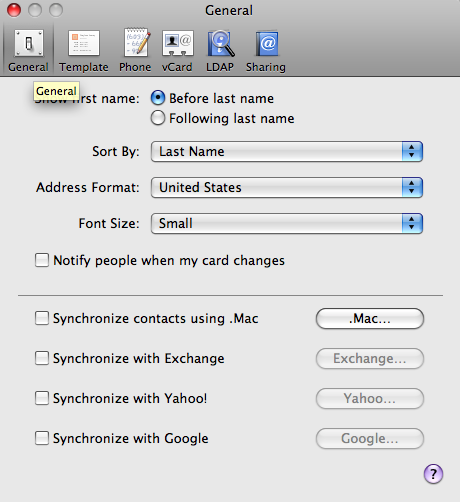
I was excited by the recent update to Apple’s own Address Book application that revealed a “sync with Google” option– albeit only if you happen to have connected an iPod touch or iPhone to that computer. Unfortunately, the offering is less than transparent.
Continue reading Apple’s Address Book Syncing is too Course-grained
I often begin reasoning from first principles of which I may not initially be aware; they unfold to me as I explain my thinking over minutes, days, and weeks. I don’t see this as a matter for concern. I follow in the step of many writers who have expressed the idea that they learn what they think as they write and re-write it.
However, this can lead to the impression that I’m not trying to be precise or decisive. Quite the opposite is true. My willingness to continue refining my thoughts, often times in private and slowly, is just that: my attempt to be both precise and decisive, albeit in the face of imperfect information.
How can any of us claim to be honestly engaged in conversation if we’re unwilling or unable to refine our thoughts?
We often find ourselves commenting on students’ writing and acting as editors rather than critical readers: we indicate line-level edits, such as missing commas and poor word choices– as if fixing the mechanical errors would make the paper acceptable. In reality, most student papers we see are first drafts, often written the night before the assignment is due and unedited by anyone, including the author. (See my post concerning the design of assignments, coming soon.)